
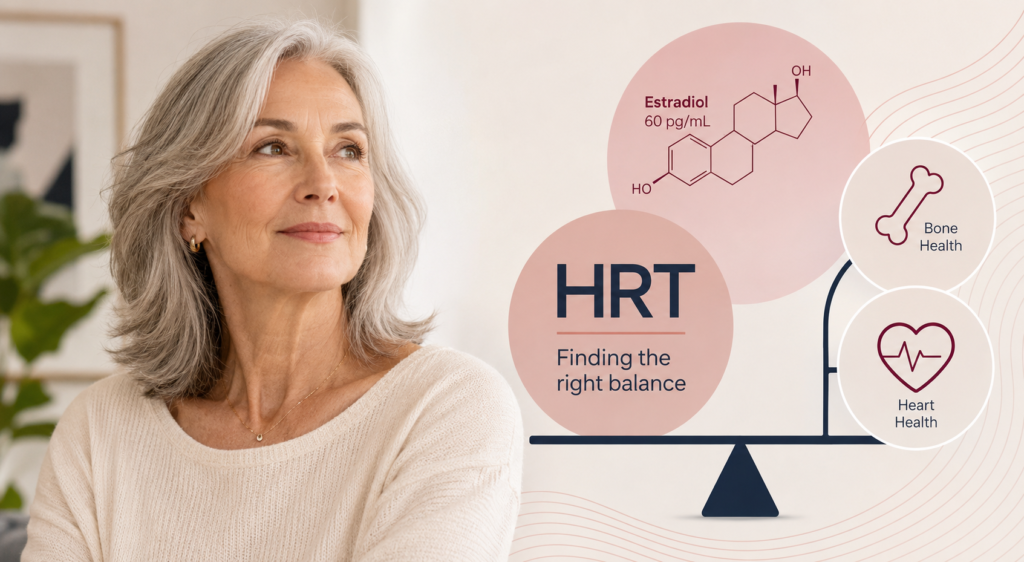
If you’ve ever started hormone therapy and wondered, How do I know if my dose is actually doing enough?, then you’re asking a much more complicated question than it sounds.
We tend to think about HRT (Hormone Replacement Therapy) in very simple terms: take estrogen, feel better. But estrogen does more than manage hot flashes.
Estrogen interacts with tissues throughout the body, including the bones and cardiovascular system. And once we start thinking about hormone therapy as something that may affect our long-term health, and not just symptom relief, the question changes.
Instead of “Are my hot flashes better?”, we can start asking:
“Is my body getting enough estrogen exposure to potentially benefit my bones and heart, too?”
A new paper published in Gynecological Endocrinology takes a closer look at that question.
The study, “Optimizing estradiol serum levels for optimal skeletal and cardiovascular health during transdermal menopausal hormone therapy,” by Paul Charles M. Piette and James A. Simon, where they looked at estradiol blood levels associated with symptom relief and compared them with levels seen in previous research on bone and cardiovascular health.
And one number in particular stands out: around 60 pg/mL of estradiol.
But before you grab your lab results and start comparing numbers, there’s a little more to the story.
I’ve talked about this so much on the Hack My Age podcast, including in my episode Hormone Therapy and Bone Health in Menopause, What the Research Actually Shows. In that episode, I dig into estrogen’s role in bone remodeling, what happens to bone density during menopause, the research around HRT and fracture risk, and why hormone therapy works best as part of a broader bone-health strategy.
What’s This About?
This study asks whether the amount of estradiol circulating in the blood while using transdermal HRT might help identify a level that’s associated with symptom relief as well as bone and cardiovascular benefits.
I first want you to understand some langage here.
Estradiol is the main form of estrogen made by the ovaries during our reproductive years. Estrogen levels naturally fall during the menopausal transition. It’s inevitable, no matter how healthy we are.
Menopausal hormone therapy (MHT), also called HRT, replaces some of that lost hormone. In this paper, the researchers focus on transdermal estradiol, meaning estrogen absorbed through the skin using products such as gels or patches.
The researchers were interested in something really specific: serum estradiol concentration, which means the amount of estradiol measured in the blood. Serum = blood test.
Why? Because there’s a big difference between saying, “This dose of estrogen is prescribed” and knowing how much estrogen actually ends up absorbed and circulating in a woman’s body.
The main question they wanted answered was, “Could blood estradiol levels help clinicians better understand whether a woman’s HRT is providing enough estrogen to potentially support more than symptom relief?”
The authors argue that existing evidence points toward approximately 60 pg/mL as a potentially meaningful level when using transdermal estradiol. Remember, this is potentially. It’s not necessarily your number. You may need more or can get away with less.
The paper is exploring whether estradiol blood levels could provide another piece of the puzzle when individualizing HRT.
When and Who?
The paper was published online July 8, 2026, and analyzed data involving 567 women from two phase 3 trials of transdermal estradiol gel.
The women in the two pivotal trials were postmenopausal and received different doses of estradiol gel or an estradiol patch.
In the first trial, women were given either 1.25 g or 2.5 g of estradiol gel daily, or placebo, for 12 weeks.
The second trial compared three different estradiol gel doses with a 50-microgram-per-day estradiol patch.
The researchers then compared the resulting estradiol levels with data from two well-known studies:
- KEEPS, the Kronos Early Estrogen Prevention Study
- ELITE, the Early versus Late Intervention Trial with Estradiol
KEEPS followed 727 healthy women who were 42 to 58 and within three years of menopause. ELITE investigated whether the timing of estrogen therapy influenced cardiovascular effects.
This is an important point:
The 567 women were not all part of one new trial designed to prove that 60 pg/mL prevents heart disease or osteoporosis.
Instead, the authors connected findings from several studies to build a case for a potentially useful estradiol target.
This is a data analysis and comparison of existing clinical trial evidence, not a single new trial proving one universal HRT target.
What Did the Researchers Find?
Higher transdermal estradiol exposure was associated with substantial reductions in moderate-to-severe hot flashes.
In the first study, women using 2.5 g of estradiol gel daily went from an average of about 10.5 moderate-to-severe hot flashes per day to about 2. That’s an 82% reduction. The 1.25 g dose produced a 73% reduction.
In the second trial, the 2.5 g gel dose reduced moderate-to-severe hot flashes from 11.8 to about 2.3 per day. The estradiol patch produced a similar reduction, from 10.9 to about 1.3 per day.
So the first message isn’t totally surprising: Estradiol works for vasomotor symptoms.
Vasomotor symptoms are the medical term for hot flashes and night sweats.
But the researchers weren’t only interested in whether women stopped sweating through their shirts. They wanted to know what those estradiol levels might mean for the rest of the body.
Could the same estradiol level help protect your bones and heart?
The authors argue that an estradiol level around 60 pg/mL may correspond to the range associated with meaningful skeletal and cardiovascular benefits in previous research.
This is where the paper gets particularly interesting.
Estrogen isn’t just a reproductive hormone.
After menopause, declining estrogen contributes to increased bone turnover and can accelerate bone loss, which can increase our risk of fractures. Estrogen also has an impact on the cardiovascular system.
The authors compared the estradiol levels achieved in the transdermal gel trials with levels associated with outcomes from KEEPS and ELITE.
Their conclusion was that approximately 60 pg/mL was a level that corresponded with the beneficial effects seen in those previous studies.
That’s potentially significant because it moves the conversation beyond: “Is your HRT helping your hot flashes?” and toward: “Are we thinking about hormone therapy as part of long-term health?”
But keep in mind, 60 pg/mL is not a magic number.
The authors themselves acknowledge that the actual numerical estradiol value isn’t necessarily the whole story. The body needs enough estrogen to activate estrogen receptors, and we all know we are bioindividual, meaning individual hormone levels can vary.
The paper therefore advocates individualized decision-making, rather than treating 60 pg/mL as a universal prescription target. I couldn’t agree with this more. The paper proposes ~60 pg/mL as a potentially useful reference point, not a one-size-fits-all target that every woman on HRT should chase.
Does this mean your HRT dose should be increased?
No. This study does not show that every woman should increase her HRT dose to reach 60 pg/mL.
This is probably the most important part of the article.
It can be tempting to read “60 pg/mL” and think: Wait. Mine is 38. I need more estrogen.
That’s not what this study proves. HRT decisions depend on much more than a single blood test.
Your age, time since menopause, symptoms, medical history, cardiovascular and clotting risk, whether you have a uterus, the type and route of hormone therapy you’re using, and your individual goals all matter.
I also want you to remember that estradiol blood testing isn’t necessarily a perfect way to determine whether a particular woman is receiving the “right” dose.
Hormone levels fluctuate, different formulations produce different patterns of absorption, and a lab number doesn’t always tell us exactly how a person is responding clinically.
The paper’s point is so much more nuanced.
It just suggests that serum estradiol concentration may be one useful piece of information when individualizing transdermal HRT, particularly when considering broader goals such as bone and cardiovascular health.
Don’t self-adjust HRT based on this study or chase a number without discussing the full picture with your clinician.
Why Does This Matter?
Because menopause isn’t only about hot flashes. It’s also a major transition for bone and cardiovascular health. We sometimes talk about menopause as though the main objective is simply to get through the symptoms.
Survive the night sweats.
Get some sleep.
Stop throwing your sheets off at 3 a.m.
And yes, symptom relief matters enormously.
But menopause also happens at the same time that several longer-term health risks begin changing.
Your bones. Estrogen helps regulate bone remodeling, the continuous process through which old bone is broken down and new bone is built. When estrogen falls, bone loss can accelerate.
That matters because osteoporosis is silent. You don’t know your bones are becoming weaker until a fracture happens.
Your cardiovascular system. Cardiovascular disease is the leading cause of death in women globally, and menopause brings changes in cardiovascular risk factors. It’s also a silent killer.
The timing of hormone therapy matters here. Previous research such as KEEPS and ELITE explored cardiovascular outcomes in women who started hormone therapy relatively close to menopause.
This is why the concept of a “window of opportunity” appears in menopause research.
It refers broadly to the idea that the balance of benefits and risks associated with starting hormone therapy may be different when treatment begins closer to the onset of menopause than when it is started much later.
That does not mean HRT is automatically appropriate for everyone who is recently menopausal.
It means timing is one of the factors that matters.
HRT is not simply a hot-flash treatment, in my opinion. For some women, the decision involves thinking about symptoms alongside longer-term bone and cardiovascular health.
What Am I Doing About It?
I’m trying to think about menopause through the lens of the woman I want to be decades from now, not just the symptoms I’m feeling today. That means I’m interested in the bigger picture:
Bones.
Muscle.
Heart health.
Metabolic health.
Vaginal health.
Brain health.
And yes, hormones.
This is also why I don’t think the HRT conversation should be reduced to “HRT: good or bad?” That’s too simplistic. The more useful questions are:
Who is it appropriate for? When should it be started? Which form makes sense? What dose? What are the individual’s risks and benefits? What are we trying to accomplish? And how do we reassess over time?
Personally, I’m not interested in chasing a perfect hormone number. I’m interested in understanding what the evidence says and using it to make smarter, more individualized decisions.
Practical Tips
Start by treating HRT as one part of your long-term health strategy, not a standalone solution. Here are the practical takeaways I would put on your list:
1. Know why you’re taking HRT. Are you treating hot flashes? Sleep disruption? Genitourinary symptoms? Bone protection? Or are there several goals? Knowing the goal makes it much easier to evaluate whether your treatment is doing what you need it to do.
2. Don’t automatically chase 60 pg/mL. This is worth repeating. A study suggesting ~60 pg/mL is associated with beneficial outcomes does not mean every woman needs to reach exactly 60 pg/mL. Your treatment should be individualized.
3. Ask about the route of estrogen. This paper specifically focuses on transdermal estradiol, meaning estrogen delivered through the skin. That includes things like patches, sprays, creams and gels. The route matters because oral and transdermal estrogen are not the same. The authors specifically highlight transdermal therapy in their analysis.
4. Don’t forget the progesterone conversation. If you have a uterus and are using systemic estrogen, progesterone or another progestogen (even synthetic progesterone, progestin) is generally used to protect the uterine lining. The studies discussed in this paper used micronized progesterone alongside transdermal estradiol in the relevant regimens. Your estrogen dose cannot be considered in isolation from the rest of your hormone therapy.
5. Think beyond your symptoms. Ask yourself, “What else am I doing for my bones? What am I doing for my cardiovascular health? What am I doing to preserve muscle and strength?”. HRT may be part of that strategy, but it isn’t the only strategy. You cannot “out-hormone” a poor diet and lifestyle.
6. Build your bone bank now. Strength training, adequate protein, appropriate calcium and vitamin D intake, balance training, and other lifestyle factors can all play a role in maintaining skeletal health. Don’t wait for a bone-density scan to start caring about your bones.
7. Have an actual HRT conversation with your clinician. Rather than asking: “What’s the lowest dose I can take?” Try asking: “What are we trying to achieve with my HRT, what are the risks of skipping HRT, and how will we know whether it’s working for me?”
What are the limitations of this study?
The biggest limitation is that the paper does not directly prove that maintaining an estradiol level of 60 pg/mL prevents osteoporosis or cardiovascular disease.
This is really important to understand.
The researchers analyzed estradiol concentrations from two phase 3 trials and compared them with findings from KEEPS and ELITE. They used those comparisons to argue that approximately 60 pg/mL may represent a useful level for optimizing the balance of symptom relief and potential skeletal and cardiovascular benefits.
That is different from conducting a large randomized trial in which women are assigned to different estradiol blood-level targets and followed for years to see who develops fractures or cardiovascular disease.
The original pivotal trials also primarily examined short-term symptom efficacy and safety, with the key hot-flash outcomes assessed over 12 weeks.
So this paper is interesting and hypothesis-generating, but it shouldn’t be interpreted as proof that every woman needs to maintain a specific estradiol concentration. You do you.
There’s also a disclosure where the authors report industry relationships, including consulting relationships, and the earlier pivotal studies discussed in the paper were sponsored by Solvay Pharmaceuticals.
This doesn’t make the findings wrong, or we just throw out the baby with the bathwater.
It does mean we should read them with the appropriate level of scrutiny.
This is a useful piece of evidence in the HRT conversation, not the final word on an “optimal” estradiol number.
So, what should you remember?
If you remember only five things from this article, make them these:
1. Estradiol does much more than control hot flashes. It has important effects on bones and interacts with cardiovascular health.
2. This paper highlights approximately 60 pg/mL as a potentially meaningful estradiol level. The authors connect that level with findings from previous research on symptoms, skeletal health and cardiovascular outcomes.
3. 60 pg/mL is not a magic number. It shouldn’t become another target women feel pressured to hit.
4. Your HRT dose should be individualized. The right treatment depends on your symptoms, health history, timing, formulation, route, risks and goals.
5. Don’t think about menopause in isolation from your future self. Your 80-year-old self will care very much about whether you preserved her bones, muscle, heart health, mobility and independence.
And that’s really the bigger conversation.
Menopause isn’t just about getting rid of hot flashes.
It’s about asking what we can do today to give the woman we’ll become the best possible starting point. And even so, there are no guarantees in life.
FAQ: Estradiol & HRT
Can estradiol levels be too low during HRT?
Yes. If estrogen exposure is insufficient, menopausal symptoms may persist and some of the physiological effects of estrogen replacement may not be achieved. However, this study does not establish one blood level that is “too low” for every woman.
Does a higher estradiol level mean better protection?
Not necessarily. More hormones aren’t automatically better. HRT needs to be individualized to balance potential benefits, symptom control and risks. I don’t like the word “protect”, because it give us a false sense of security that we don’t need to do the hard work of lifestyle and diet changes.
Should women have their estradiol levels tested while taking HRT?
I am a fan of testing, but not all doctors agree Whether testing is useful depends on the individual situation, the type of HRT being used and the clinical question being asked. A blood test should not be treated as a standalone measure of whether HRT is “working.” But, it depends on your goals – check your cardiovascular numbers, bone health and insulin are just as important as estradiol and testosterone levels.
Can HRT prevent osteoporosis?
Systemic hormone therapy can help reduce bone loss and has a role in osteoporosis prevention for some menopausal women. Whether it is appropriate specifically for bone protection depends on an individual’s age, fracture risk, health history and other treatment options. “Prevention” goes in the same category as “protection”, we cannot ignore the other parts of the puzzle to bone health. Your bones may need more than just HRT.
Does transdermal estrogen have different risks from oral estrogen?
Yes. The route of estrogen administration can affect its physiological effects and risk profile, which is one reason HRT needs to be individualized. The paper specifically focuses on transdermal estradiol delivered through gels and patches.
Can you start HRT years after menopause?
Yes, but the benefit-risk calculation changes with age, time since menopause and individual health factors. The timing of HRT initiation is an important part of the clinical decision and should be discussed with a qualified healthcare professional.
Zora Benhamou is a gerontologist who studies aging and is dedicated to challenging menopause stigma and ageist stereotypes. As the host of the Hack My Age podcast, she focuses on empowering women navigating the menopausal transition through evidence-based techniques that support your 80 year old self.
Reference: Piette, P. C. M., & Simon, J. A. (2026). Optimizing estradiol serum levels for optimal skeletal and cardiovascular health during transdermal menopausal hormone therapy. Gynecological Endocrinology, 42(1).