
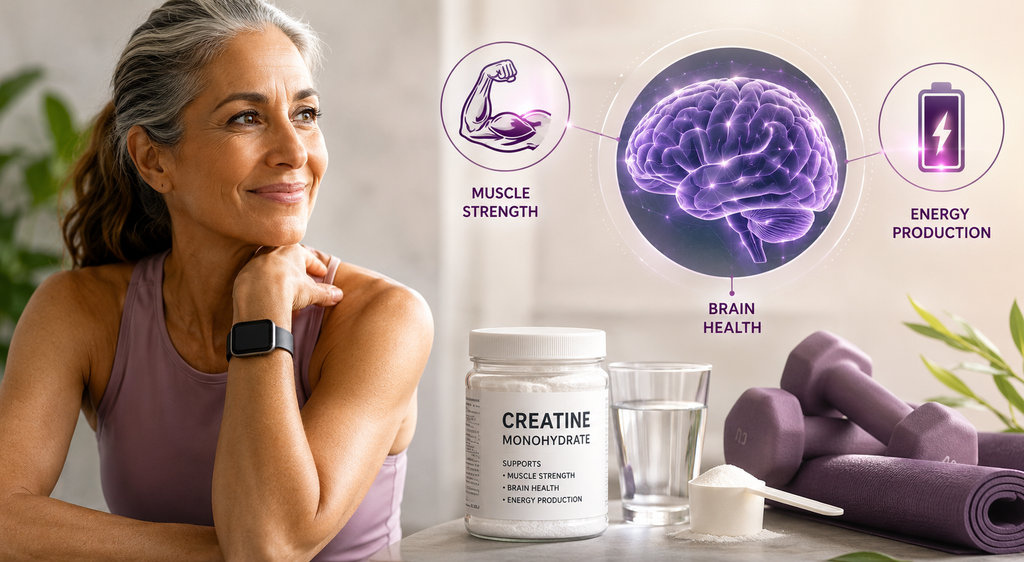
Creatine for the last several decades has been associated with the body building community and athletes as a gym supplement that helps with building muscle, but some research suggests that maybe we need to look a bit wider.
As women move through perimenopause and menopause, maintaining muscle, strength, physical function and even brain health becomes more and more important. And researchers are starting to ask whether creatine could be useful for women for reasons that go way beyond the gym.
In a 2021 review published in Nutrients “Creatine Supplementation in Women’s Health: A Lifespan Perspective.” authors reviewed research on creatine throughout the female lifespan, including what happens around menopause.
They found that creatine looks promising for supporting muscle strength and physical function in women, particularly when combined with resistance training. There is also intriguing evidence around brain energy, cognition and mood. But hang on, not so fast, the menopause-specific research is still developing.
What is creatine, and why should women care?
Creatine is a naturally occurring compound that helps your cells produce energy quickly.
The body can make creatine, but we also get some from the foods we eat, such as meat and fish. Much of our creatine is stored in skeletal muscle, where it helps regenerate ATP, our body’s energy currency.
Think of ATP as the body’s rechargeable battery. When we lift something heavy, climb stairs, sprint, or do another short burst of intense activity, our muscles need energy quickly. So creatine helps the muscles recycle that energy faster.
But did you know that your brain also uses creatine?
The brain needs a lot of energy, and creatine and phosphocreatine help support the energy system that keeps brain cells working their best.
The 2021 review points out that women have been significantly underrepresented in creatine research despite decades of research on the supplement. It also notes that women have been reported to have 70 to 80% lower endogenous creatine stores than men, although women can have relatively high resting muscle creatine concentrations.
That doesn’t mean every woman is “creatine deficient”, but means that there are biological differences worth studying and menopause may be one of the most interesting times to look at them.
Creatine isn’t a steroid and it isn’t a hormone, but a naturally occurring compound involved in energy production in both muscle and brain tissue.
What happens to creatine during menopause?
When we go through menopause, the hormonal environment that influences how the body handles energy, muscle and bone changes.
Estrogen not only has a reproductive role, but also interacts with systems involved in metabolism, muscle, bone and cellular energy.
The authors of the review describe creatine metabolism as being influenced by sex hormones, particularly estrogen and progesterone. They suggest that these hormone-related changes may make creatine particularly relevant during the menopause transition and after menopause.
And that matters because menopause already brings changes that can make maintaining muscle and strength more challenging.
As estrogen declines, muscle mass and strength become harder to preserve, while bone loss can accelerate. And many women notice that the same workout routine that once worked for them suddenly doesn’t seem to give the same results. But this doesn’t mean creatine is a replacement for estrogen.
The researchers are interested in whether supporting the body’s energy systems could help offset some of the downstream consequences of the menopause transition.
Creatine doesn’t “balance” or replace our hormones either. The interesting question is whether it can help our muscles and brain cope with changing energy demands during midlife.
I’ve also talked about creatine and protein on the Hack My Age podcast with Angelo Keely. The episode discusses protein, amino acids, muscle, healthy aging and how creatine fits into that picture.
What did they find?
The review looked at multiple studies involving women and found substantial evidence that creatine can improve strength and power, particularly when combined with resistance training, which actually makes biological sense.
Creatine increases the amount of phosphocreatine available in the muscles, which then helps our muscles regenerate ATP more quickly when the exercise gets more intense.
You may be able to squeeze a little more quality work out of your muscles, which may not sound like a lot, but over months and years can accumulate.
Because the goal isn’t simply to lift heavier weights for the sake of lifting heavier weights, but to maintain the muscle that helps you:
- Carry your groceries
- Get up from a chair
- Climb stairs
- Travel independently
- Recover from illness or surgery
- Stay physically capable as you age
The review found that several studies in postmenopausal women reported improvements in lean tissue, strength and functional measures when creatine was combined with resistance training. But not every study found an additional benefit, particularly for bone or some measures of muscle strength.
So creatine isn’t a miracle.
It seems to work best as part of a bigger strategy that includes resistance training. So if you’re taking creatine but never challenging your muscles, you’re probably missing one of its biggest potential benefits.
Can creatine help protect bones after menopause?
Maybe indirectly, but the evidence is not strong enough to call creatine a bone-loss treatment.
The 2021 review found some promising evidence when creatine was combined with resistance training. One longer study found that creatine plus resistance training reduced the rate of bone mineral density loss in the hip region and increased a measurement associated with bone strength.
But other studies found no significant additional benefit for bone mineral density or bone turnover.
The authors ultimately concluded that creatine alone, or even creatine combined with resistance training, did not consistently improve bone physiology in postmenopausal women, so they said we need larger and longer randomized controlled trials.
So if someone tells you, “Creatine prevents osteoporosis.”
That’s going too far.
A more accurate statement is: Creatine may support the muscle and strength side of healthy aging, and when paired with resistance training, it may have some favorable effects on bone. But it should not be considered a proven treatment for osteoporosis.
The key word here is “may”. Think of creatine as potentially supporting the muscle-and-movement ecosystem that helps you age strongly, rather than as a bone medication.
Could creatine help your brain too?
Maybe. Evidently, the brain is also an energy-hungry organ.
Creatine and phosphocreatine help the brain regenerate ATP, particularly when energy demands are high.
The review discusses evidence suggesting creatine supplementation may support cognition and reduce mental fatigue, particularly during periods of stress or sleep deprivation. This could be really interesting for women going through the menopause transition.
One of the biggest complaint women have when going through menopause is brain fog. Keep in mind though that there can be many reasons for brain fog like poor sleep, stress, medications, mood changes and other health conditions.
But the researchers are asking whether changes in brain energy metabolism could also play a role.
The review notes that women may have lower brain creatine concentrations in certain regions, including the frontal lobe, which is involved in cognition, memory, mood and emotion, but that doesn’t mean creatine is a “brain fog cure.” It just means there’s a plausible biological reason to investigate it.
Newer research, such as the 2025 randomized controlled trial called CONCRET-MENOPA studied 36 healthy perimenopausal and postmenopausal women for eight weeks. Researchers found that the medium-dose creatine hydrochloride group had faster reaction times on cognitive testing and increased brain creatine levels compared with placebo. There were also some potentially favorable changes in blood lipids, while changes in mood did not reach strong statistical significance.
It was a small study, so we shouldn’t get carried away, but it is an intriguing step forward.
So, all in all, creatine supplementation may go beyond just muscle health. The latest research suggests it could influence brain energy and cognition, but, as usual, larger menopause-specific trials are still needed.
What about mood and depression?
Here we go. What else can creatine do?
The 2021 review discusses research linking brain creatine metabolism with mood and depression, but it’s not a replacement for treatment with medication.
Some studies found that creatine supplementation alongside antidepressant medication improved depressive symptoms in females, which is interesting because the brain’s energy system and neurotransmitter systems are closely connected.
However, these two statements are NOT the same.
“Creatine may support brain energy and has shown promise in mood research.”
and:
“Creatine treats depression.”
If you’re feeling significant depression, anxiety or persistent changes in mood, please discuss this with a qualified healthcare professional.
Creatine may eventually prove to have a role here, but the evidence isn’t strong enough to make it a replacement for established treatments.
Why does this matter for women in midlife?
As a gerontologist, I know that preserving muscle is one of the smartest things we can do for our future health. Sadly, most of us think of muscle as just something aesthetically pleasing. How toned are my arms? How do my legs look in these shorts?
There is nothing wrong with vanity, but muscle is so much more than looks. It’s a tissue that helps our metabolism and plays a big role in movement, blood sugar regulation, physical independence, and resilience.
As we get older, many people fall into sarcopenia, which is age related muscle loss, but this is completely avoidable. Losing muscle and strength can eventually make everyday activities harder.
So the question isn’t: “How can I stay lean?”
A better question is: “How can I stay strong enough to live the life I want at 70, 80 and 90?” and that’s why creatine is interesting, because it may be one small tool that helps support the physical capacity we want to carry into later life.
What am I doing about it?
I’m looking at creatine as part of a bigger longevity strategy, not as a magic menopause supplement.
I’ve become increasingly interested in creatine because the research is moving beyond the traditional “gym supplement” conversation.
I’m particularly interested in the combination of creatine + resistance training + adequate protein because those three pieces help keep muscle and our physical function as we age.
The emerging research around the brain is also interesting to me.
My approach is simple: Don’t chase one supplement. Build the foundation first.
That means strength training, sufficient protein, good sleep, movement, nutrition, stress management and nurturing my community and relationships.
Then, if creatine makes sense for you, it can potentially become another tool in the toolbox.
How much creatine should women take?
For most women interested in creatine for general muscle support, 3 to 5 grams of creatine monohydrate per day is the commonly studied maintenance range.
The 2021 review describes two broad approaches: a loading strategy followed by a maintenance dose, or simply taking around 5 grams daily. A daily 5-gram approach takes longer to fully saturate muscle stores, roughly three to four weeks.
I personally wouldn’t assume high dose protocols are better, even if there is some research on it.
The review discusses loading protocols as high as 20 grams per day for several days, but those are specific research protocols, not a recommendation that every woman needs to take 20 grams a day.
And newer menopause research is looking at much lower doses for brain effects. The 2025 CONCRET-MENOPA trial, for example, tested doses ranging from 750 mg to 1,500 mg per day in different groups.
The science is still figuring out whether the “best” dose for muscle is necessarily the best dose for the brain. But until then, I am just going with keeping things simple and saving a bit of money. Speak to your own healthcare professional if you’re considering supplementation.
Does creatine cause weight gain?
It can increase weight on the scale in some people, but that doesn’t necessarily mean fat gain.
Creatine pulls water into muscle cells, particularly when someone uses a loading phase, which can make that number on the scale to go up. And this is one reason women sometimes avoid creatine unnecessarily.
But water stored in muscle is not the same thing as gaining body fat.
The review notes that concerns about weight gain and side effects have contributed to women’s reluctance to use creatine, while the available evidence in women has generally found a favorable safety profile at recommended doses.
If your goal is to maintain muscle and strength, a small increase in muscle water isn’t necessarily something to fear.
Is creatine safe for women?
Current evidence suggests creatine monohydrate is generally well tolerated in healthy women when used at studied doses.
The review cites a systematic review finding no clear increase in gastrointestinal, kidney, liver or cardiovascular adverse effects among women taking creatine.
That said, “generally safe” doesn’t mean “appropriate for everyone.”
If you have kidney disease, are pregnant or breastfeeding, take medications, or have another medical condition, speak with your healthcare professional before starting a supplement.
And remember that supplements aren’t regulated in exactly the same way as prescription medications.
Quality matters.
What are the practical ways to use creatine?
Keep it boring. Boring is good. Here are the practical takeaways I’d focus on:
1. Choose creatine monohydrate. Creatine monohydrate is the most extensively studied form. You don’t need a fancy “advanced” version simply because the packaging promises more. I personally like the creatine by Puori*
2. Take it consistently. Creatine works by gradually increasing stores in your tissues. It’s not like caffeine where you take it and immediately feel a jolt. Consistency matters more than perfect timing.
3. Pair it with resistance training. This is probably the biggest takeaway. If your goal is healthy aging, don’t think: Creatine OR strength training, its Creatine + strength training. The research in postmenopausal women is much more interesting when the two are combined.
4. Don’t panic if the scale moves. A little extra water inside your muscles isn’t the same as gaining fat. Look at your strength, measurements, how your clothes fit and how you feel, not just the bathroom scale.
5. Don’t expect overnight results. Creatine is about building up tissue stores. A consistent daily dose may take several weeks to fully increase muscle creatine levels.
6. Don’t use creatine to replace the basics. If you’re sleeping five hours a night, eating very little protein and never strength training, adding creatine isn’t going to magically fix the problem. Your foundation still matters most.
7. Talk to your healthcare professional. Especially if you have a medical condition, take medications, or are unsure whether creatine is appropriate for you.
Creatine is one of the more promising supplements for supporting muscle strength and physical function in women, but the menopause-specific evidence is still evolving.
The 2021 review makes a compelling case that women deserve much more research on creatine, particularly during and after menopause. The evidence for muscle and strength is stronger than the evidence for bone, mood or cognition.
A newer 2025 randomized trial in perimenopausal and postmenopausal women found that a medium dose of creatine hydrochloride improved reaction time and increased brain creatine levels over eight weeks, although the study was small and much more research is needed.
So I’m not ready to call creatine a menopause miracle, but I am paying attention, because when we’re talking about geroscience, the goal isn’t simply to live longer. It’s to remain strong, capable, sharp and independent for as many of those years as possible.
And if something as simple as creatine can help support that goal, it’s certainly worth keeping on the radar.
FAQ’s: Creatine & Menopause
Can you get enough creatine from food?
Yes. Creatine occurs naturally in foods, particularly animal foods such as meat and fish. However, dietary intake varies considerably, which is one reason supplementation has been studied as a way to increase creatine stores.
Is creatine suitable for vegetarians and vegans?
Potentially, and this is an interesting area of research. People who consume little or no animal protein may have lower dietary creatine intake, and some studies suggest they may respond particularly well to supplementation.
Does creatine help with menopause weight gain?
Creatine is not a weight-loss supplement and shouldn’t be marketed as one. Its more established role is supporting muscle energy, strength and physical performance. Any change in scale weight after starting creatine may partly reflect increased water stored in muscle rather than increased body fat.
Should I take creatine on rest days?
Yes, if you’re using a daily maintenance approach. Creatine works by maintaining elevated tissue stores, so there is generally no reason to take it only on workout days.
Does creatine help women build muscle after 50?
Research suggests it can help support muscle strength and lean tissue, particularly when combined with resistance training. However, results aren’t identical across every study, and creatine works best as part of an overall strength-training and nutrition strategy.
Can creatine replace protein?
No. Creatine and protein do different jobs. Protein supplies amino acids needed to build and repair tissue, while creatine supports the rapid regeneration of cellular energy. They can complement each other but aren’t interchangeable.
Is creatine the same thing as creatinine?
No. Creatine is a compound involved in energy storage and production. Creatinine is a waste product produced from creatine metabolism and is commonly measured in blood tests as one indicator used when evaluating kidney function.
*Puori Creatine – code HACKMYAGE 20% off
Zora Benhamou is a gerontologist who studies aging and is dedicated to challenging menopause stigma and ageist stereotypes. As the host of the Hack My Age podcast, she focuses on empowering women navigating the menopausal transition through evidence-based techniques that support your 80 year old self.
Reference: Smith-Ryan, A. E., Cabre, H. E., Eckerson, J. M., & Candow, D. G. (2021). Creatine supplementation in women’s health: A lifespan perspective. Nutrients, 13(3), 877.