
What… the Menopause?
Each week we spotlight an unexpected and frustrating symptom of menopause that no one warned you about. Because menopause is more than just hot flashes and missed periods.
This week’s spotlight: Drier Scalp and Dandruff
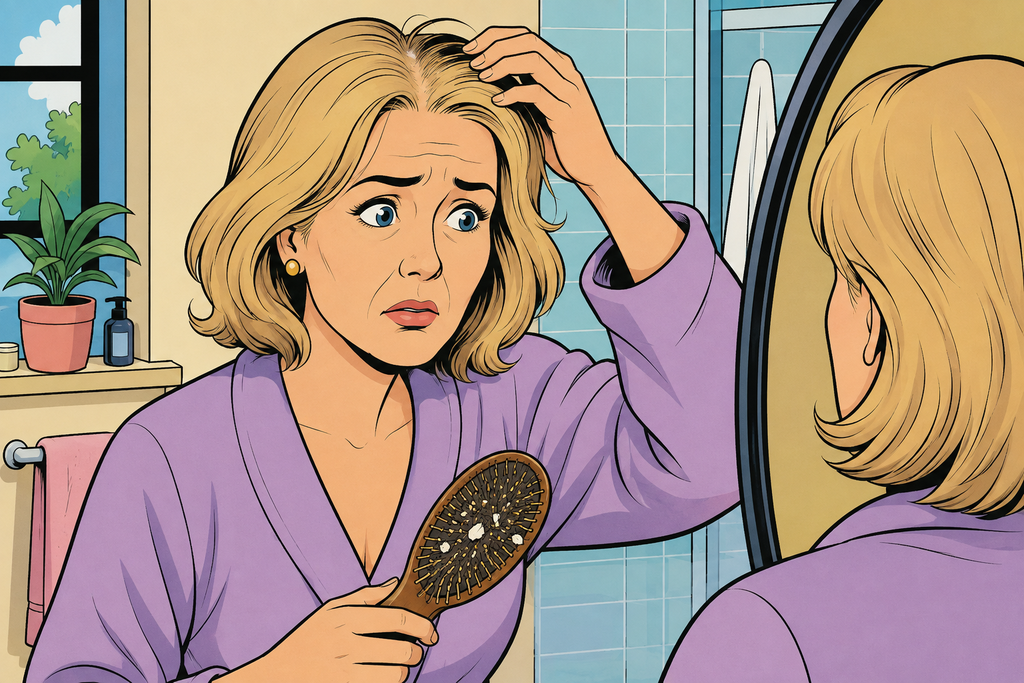
Have you noticed recently that your scalp feels tight and it’s itchy? Or maybe you see little white flakes on your shoulders while your hair suddenly feels drier too, even though you haven’t changed your shampoo, your routine, or anything else.
And naturally, you start wondering if this is just aging, or if you’re washing your hair wrong.
Well, menopause may be part of the picture.
Hormonal changes during perimenopause and menopause really can affect the skin’s hydration, barrier function and oil production, and that can leave the scalp feeling drier and a little more sensitive. But did you know that a dry scalp and dandruff aren’t necessarily the same thing.
Dandruff is generally considered a mild form of seborrheic dermatitis, a common scalp condition involving flaking and changes in the interaction between skin oils, the scalp microbiome and individual susceptibility.
I’ve spent a significant amount of time exploring hair health, including a Hack My Age episode with Dr. Alan Bauman, which focused on thinning hair, hormonal changes, scalp health, nutrients and hair-growth strategies.
So before you start buying every “anti-dandruff” product on the shelf, let’s figure out what’s actually going on.
What causes a dry scalp during menopause?
Declining estrogen during the menopause transition can contribute to scalp dryness because estrogen is associated with changes in skin hydration, barrier function and oil production.
Research has found that as estrogen levels declines, changes in skin hydration, thickness, elasticity and barrier function also declines. All of which makes your scalp feel drier.
And then there is the aging process itself.
Your scalp is skin. So while you’re thinking about collagen loss, wrinkles and dry skin on your face, the skin on your scalp is also going through changes.
Is dandruff caused by a dry scalp?
Not necessarily. Dandruff is usually linked to the scalp microbiome, skin oils and a yeast called Malassezia rather than simply having a “dry” scalp.
Malassezia sounds awful, but it’s actually a normal part of the skin microbiome. In susceptible people, the interaction between this yeast, scalp lipids and the skin’s inflammatory response can contribute to dandruff and seborrheic dermatitis.
This is why aggressively moisturizing your scalp isn’t always the answer.
If you have a genuinely dry scalp, you may notice tightness, sensitivity and small dry flakes.
If you have dandruff, you may notice recurring flakes, itchiness and sometimes greasy or yellowish scaling.
And yes, you can have both.
What does menopause have to do with it?
Menopause doesn’t appear to directly “cause dandruff,” but hormonal changes can alter the skin environment of the scalp and may make existing scalp problems more noticeable.
Research on menopausal skin consistently shows that declining estrogen is associated with dryness and changes in skin barrier function. So, why would the scalp be excluded?
At the same time, dandruff and seborrheic dermatitis are influenced by several factors, including age, skin biology, scalp oils, the microbiome, stress and individual susceptibility.
In other words, menopause may be just one piece of the puzzle, not the entire puzzle.
If your scalp suddenly becomes dry, itchy or flaky in midlife, don’t automatically assume you have “bad hair.” Your scalp is skin, and your skin is changing too.
How common are dandruff and scalp problems after 40?
Dandruff is extremely common, and affects around half of the general population, while seborrheic dermatitis affects a smaller percentage of adults.
Dandruff is considered one of the most common scalp conditions worldwide, with estimates reaching approximately 50% of the general population. Seborrheic dermatitis is less common, with estimates generally around 1% to 5% of immunocompetent adults, although prevalence varies depending on the population studied.
So if you’re finding flakes in your hairbrush or on your black sweater, you’re definitely not the only one.
And while there isn’t a good population statistic showing exactly how many menopausal women get menopause-specific dandruff, we do know that menopause itself is associated with significant changes in skin hydration and function.
That’s an important distinction because there’s a tendency online to blame every new symptom on “hormonal imbalance” or menopause.
Sometimes hormones are involved and sometimes they’re not. And sometimes menopause simply happens at the same time as another condition becoming more common with age.
Dandruff is common. A suddenly dry or sensitive scalp is also something many women notice in midlife. But persistent flaking deserves a closer look rather than automatically being labeled a menopause symptom.
What can you do about a dry or flaky scalp in menopause?
Start by figuring out whether you’re dealing with simple dryness, dandruff, or another scalp condition. Then match the treatment to the problem, while getting to the root cause. Pun intended.
This is where I would resist the urge to throw ten new products at your scalp, so just start simple.
1. Don’t automatically wash less. If you’re dealing with dandruff, washing your hair less frequently isn’t always the solution.
Dandruff is associated with the scalp microbiome and skin oils, and regular cleansing can be an important part of managing it. If your scalp is genuinely dry and sensitive, however, you may need to experiment with a gentler shampoo and avoid unnecessarily harsh cleansing.
The goal isn’t “wash as little as possible.” The goal is clean enough to keep the scalp healthy without irritating it.
2. Try an evidence-based anti-dandruff shampoo. If you have recurring dandruff, look for shampoos containing an established anti-dandruff active ingredient. Common ingredients include:
- Ketoconazole
- Selenium sulfide
- Zinc pyrithione
- Salicylic acid
Different ingredients work in different ways. Some target the organisms and processes associated with dandruff, while others help loosen and remove scale.
You don’t necessarily need the strongest product. You need the right one for what is happening on your scalp. And please resist the urge to quit after a week. Just give it some time.
Anti-dandruff shampoos generally need to be used consistently rather than treated as a one-time emergency fix.
3. Don’t scratch your scalp. This one sounds obvious, but when your scalp itches, your first instinct is to scratch. Scratching can further irritate the skin and create a cycle of itching, inflammation and more irritation. Instead, focus on treating the reason your scalp is itchy.
4. Be careful with very hot water. If your scalp already feels dry or irritated, very hot showers can make things worse.
Try warm rather than very hot water, particularly when washing your hair. And pay attention to how your scalp feels after washing. Tightness and burning are useful clues that your current routine may be too aggressive.
5. Simplify your hair products. Midlife is probably not the time to start experimenting with every viral scalp oil you see on TikTok. Fragrances, essential oils and other ingredients can irritate sensitive skin in some people.
If your scalp suddenly becomes itchy or flaky, consider whether you recently introduced:
- A new shampoo
- Dry shampoo
- Hair dye
- Scalp oils
- Styling products
- Treatments or chemical processing
Sometimes the culprit isn’t menopause at all. It’s the new product sitting on your bathroom shelf.
6. Look at the bigger picture. Your scalp doesn’t exist in isolation. Stress, illness, nutritional deficiencies, medications and thyroid problems can all affect hair and scalp health. Menopause is also a period when multiple things can change at the same time.
If you’re also seeing significant hair shedding or thinning, it’s worth discussing with a healthcare professional rather than assuming everything is hormonal.
7. Know when to see a dermatologist. Persistent, severe or unusual scalp symptoms should be evaluated by a medical professional.
See a dermatologist if you have:
- Severe or persistent itching
- Red or inflamed patches
- Thick scales
- Bleeding or sores
- Patchy hair loss
- Significant or sudden hair shedding
- Pain or burning
- Symptoms that don’t improve with basic dandruff treatment
Conditions such as psoriasis, eczema, fungal infections and other forms of dermatitis can sometimes look like “just dandruff.” Getting the diagnosis right matters because the treatment can be completely different.
Don’t treat every flake with more moisturizer. First work out whether you’re dealing with dryness, dandruff, dermatitis or something else.
8. Still consider HRT. Hormone Replacement Therapy may be the low hanging fruit if the root cause really is the decline in hormones. Ask yourself if you started to feel your hair symptoms around the same time as other menopause symptoms. Because, maybe it is hormonal.
What are the most important things to remember about menopause and scalp health?
A dry scalp and dandruff are common, manageable problems, but they’re not necessarily the same thing and they shouldn’t automatically be blamed on menopause. But that also doesn’t mean to immediately rule out HRT either.
Menopause can change the skin through declining estrogen, including its hydration, barrier function and other properties.
Dandruff, meanwhile, involves a more complicated interaction between scalp oils, the microbiome and individual susceptibility.
So if your scalp suddenly feels different in your 40s or 50s, pay attention.
Your body is giving you information and the goal isn’t to panic about every change, but to understand it.
And then decide what, if anything, you want to do about it.
FAQ’s: Dry Scalp & Menopause
Can menopause make your scalp itch even without dandruff?
Yes. Menopause-related changes in skin hydration and barrier function can contribute to dryness and sensitivity, which may feel itchy even when there is no dandruff.
Can changing your shampoo suddenly cause scalp flakes?
Yes. A new shampoo, fragrance, styling product, hair dye or other topical product can irritate the scalp and cause itching or scaling in some people. If symptoms started soon after changing products, consider returning to a simpler routine.
Does stress make dandruff worse?
Stress is one factor associated with seborrheic dermatitis and can contribute to flare-ups in susceptible people.
Can dry shampoo cause scalp problems?
It can contribute to irritation or buildup for some people, particularly if it is used heavily or if the scalp is already sensitive. Dry shampoo also isn’t a substitute for cleansing the scalp.
Is scalp psoriasis the same as dandruff?
No. Scalp psoriasis is an inflammatory skin condition that can produce thicker, more defined scales and plaques. Because several scalp conditions can look similar, persistent or severe symptoms should be assessed by a dermatologist.
Can hair products make menopausal scalp sensitivity worse?
Yes. A scalp that has become more sensitive may react to fragrances, dyes, essential oils or other ingredients that previously caused no problems. If symptoms appear after introducing a new product, simplify your routine and see whether the symptoms improve.
Should I take supplements for a dry scalp?
Not automatically. Supplements are unlikely to solve every scalp problem, and taking nutrients you don’t need isn’t necessarily beneficial. If you also have significant hair shedding or other symptoms, discuss whether nutritional testing is appropriate with your healthcare professional.
Download the Menopause Symptom Tracker to help you figure it all out.
Zora Benhamou is a gerontologist who studies aging and is dedicated to challenging menopause stigma and ageist stereotypes. As the host of the Hack My Age podcast, she focuses on empowering women navigating the menopausal transition through evidence-based techniques that support your 80 year old self.