
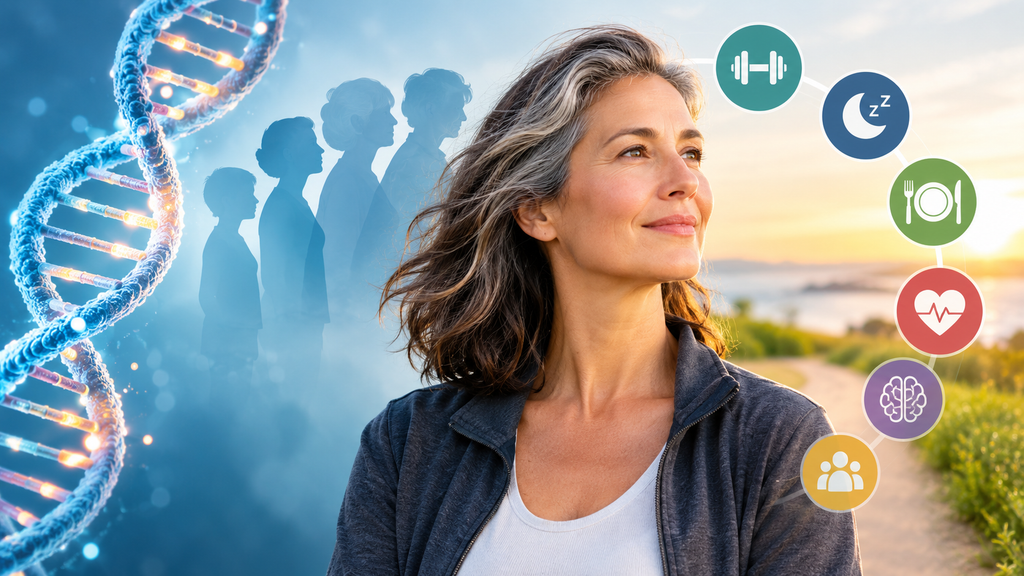
For years, we’ve been told that genetics plays only a small role in how long we live.
Some say 10% to 20%. Some large studies have put the number even lower.
The rest, we just assume, was lifestyle and environment.
We are told to eat well, exercise, don’t smoke, prioritize sleep and manage stress. Essentially, just take good care of yourself.
And while all of those things still matter enormously, a new study published in Science is challenging the way researchers have been thinking about genetics and longevity.
Your genes may have a much bigger influence on how long you live than scientists previously thought.
What is this study about?
The study asks how much of human lifespan is influenced by genetics once deaths from external causes are separated from deaths caused by the aging process itself.
Researchers from the Weizmann Institute of Science, Karolinska Institutet and Leiden University Medical Center looked at a question scientists have been wrestling with for decades:
How much of how long we live comes from our genes?
Previous research generally estimated the heritability of human lifespan at around 20% to 25%. Some more recent studies using large family trees have suggested the number could be as low as 6% to 16%.
That seems surprisingly low when you consider that lifespan is influenced by biology, and biology is heavily influenced by genetics. So the researchers asked whether something was being missed. And they found something important.
The way we have historically measured lifespan may have underestimated the genetic contribution to longevity.
The study isn’t saying that genes determine your fate. It’s saying that previous estimates may have confused how long someone lives with how long their underlying biology allows them to live.
Those aren’t necessarily the same thing.
If you want to go deeper into this idea, I talked about exactly this distinction on the Hack My Age podcast in the episode below. The conversation looks beyond simply asking how long will I live? and toward a much more useful question: How do I want to feel and function while I’m alive?
When was the study published, and who conducted it?
The study, “Heritability of intrinsic human life span is about 50% when confounding factors are addressed,” was published in Science on January 29, 2026, by researchers from institutions in Israel, Sweden, the Netherlands and China.
They analyzed historical mortality data alongside several large twin datasets, including Danish and Swedish twin cohorts. They also looked at the Swedish Adoption/Twin Study of Aging, or SATSA, which includes twins who were raised together and twins who were raised apart.
They additionally tested their model against data from siblings of U.S. centenarians. Why twins?
Because identical twins share virtually all of their DNA, while fraternal twins share about half of their segregating genes. If identical twins tend to have more similar lifespans than fraternal twins, that provides evidence that genetics contributes to lifespan.
But there’s a problem.
What if one twin dies at 25 because of an accident? That doesn’t tell us much about that person’s biological aging.
What is “extrinsic mortality” and why does it matter?
Extrinsic mortality means dying from something originating outside the body, such as an accident, homicide, infection or environmental hazard.
Intrinsic mortality refers to deaths associated with processes happening within the body, including aging-related disease, genetic factors and declining physiological function.
Think about two identical twins. They may have very similar genetic potential for longevity. But one dies at 30 from an infection while the other lives to 90. If we simply compare their ages at death, it looks like their genes didn’t matter very much. But perhaps their genes were never really given the chance to show their influence.
This is particularly important when looking at older historical populations.
The twin cohorts used in this research include people born as far back as the late 1800s and early 1900s, when infectious disease, accidents and other external causes of death were much more common.
The researchers argue that these early deaths add “noise” to lifespan measurements. That noise can make the genetic contribution to biological aging look smaller than it actually is.
If you die from something unrelated to biological aging, your age at death may tell researchers very little about your genetic potential for longevity.
What did they find?
After accounting for extrinsic mortality, the researchers estimated that the heritability of intrinsic human lifespan rises to roughly 55%. That is more than twice the commonly cited 20–25% estimate.
The researchers reached this conclusion using mathematical models and simulations, then tested their predictions against multiple human datasets. One particularly interesting test came from SATSA.
The researchers divided the Swedish twin data into groups based on when the twins were born. As extrinsic mortality decreased across these generations, the estimated heritability of lifespan increased. In other words, as fewer people died from external causes, the genetic signal became easier to see.
The study also found similar results when looking at siblings of U.S. centenarians, suggesting the finding wasn’t limited entirely to Scandinavian twin populations. The researchers’ final estimate was approximately 55% heritability of intrinsic lifespan.
That sounds huge.
But here’s where we need to slow down.
Does this mean 55% of how long you live is determined by your genes?
No. This is probably the most important distinction to understand about the study.
A heritability estimate does not mean that 55% of an individual person’s lifespan is predetermined by their DNA. Heritability is a population statistic.
It tells us how much of the variation in a particular trait, within a particular population and environment, can be statistically attributed to genetic differences. It does not tell you: “Your genes determine when you will die.”
In fact, the researchers explicitly point out that even after their correction, roughly half of lifespan variation remains unexplained by additive genetics.
That remaining variation can come from lifestyle, socioeconomic conditions, healthcare access, environmental exposures, biological randomness, epigenetic changes and other genetic effects that aren’t captured by their model.
So don’t read this study as: “Genes matter more, so there’s nothing I can do.” The better interpretation is: “Our biology matters more than we previously appreciated, but biology is only part of the longevity equation.”
And that’s actually much more empowering.
Why does this matter for women in midlife and menopause?
Because menopause sits right in the middle of the conversation about biological aging.
Menopause doesn’t determine how long you will live. And this study did not specifically study menopause. But it changes an important question we should be asking about longevity. For years, longevity conversations have often sounded like a battle against our genes:
- “My mother had osteoporosis, so I’m destined for it.”
- “My father had heart disease, so it’s inevitable.”
- “Women in my family don’t live very long.”
- “I’m just genetically unlucky.”
The reality is much more nuanced.
Your genes may influence your biological trajectory, but what happens along that trajectory is not completely predetermined.
The study itself acknowledges that environmental and lifestyle factors remain major contributors to the variation in lifespan. And this is where I think menopause becomes such an interesting window.
The menopausal transition is a major biological transition. It’s also a point when many women start paying closer attention to things they may have ignored for years:
- Muscle.
- Bone.
- Blood pressure.
- Blood sugar.
- Sleep.
- Cardiovascular health.
- Brain health.
- Hormones.
- Recovery.
These aren’t simply about looking younger. They’re about protecting the person you are becoming.
What am I doing about it?
I’m focusing less on trying to predict my lifespan and more on protecting the healthspan of my future self.
As a gerontologist, I find the 55% number fascinating. But I don’t want women walking away from this study thinking they need a genetic test to find out whether they’re “destined” to live a long life. That’s not the point.
I think the more useful question is: What can I influence today that will give my biology the best possible environment in which to age?
That’s why so much of what I talk about at Hack My Age comes back to the fundamentals:
- Building and maintaining muscle.
- Protecting bone.
- Supporting cardiovascular health.
- Prioritizing sleep.
- Managing metabolic health.
- Looking after brain health.
- Maintaining meaningful relationships.
- Understanding what is happening to your hormones rather than simply accepting every midlife change as “normal aging.”
My goal isn’t to become obsessed with adding years to my life. It’s to give my 80-year-old self as many healthy, capable and independent years as possible. And that’s a very different goal.
What can you actually do to influence healthy aging?
You can’t change your genes, but you can influence many of the biological and environmental factors that interact with them.
The important thing is not to turn longevity into another perfection project. You don’t need to do everything. Start with the things that have the biggest return.
1. Build muscle and keep it. Muscle becomes increasingly important as we age. Strength training isn’t just about having toned arms. Maintaining muscle and strength supports physical function and independence as you get older. If you’re in your 40s or 50s, this is one area I would take seriously.
2. Protect your cardiovascular health. Your heart and blood vessels don’t suddenly become important when you’re 70. Know your blood pressure; understand your cholesterol and broader cardiovascular risk; stay physically active; and don’t wait for a diagnosis before you start caring about your cardiovascular system.
3. Take bone health seriously. Bone loss can be silent. You may not feel your bones becoming weaker. That’s why midlife is an important time to think about resistance training, adequate nutrition, vitamin D where appropriate, calcium intake and whether you need a bone density assessment based on your individual risk.
4. Treat sleep as part of your longevity strategy. Sleep isn’t wasted time. It’s part of your health. If you’re waking at 3 a.m., struggling with insomnia or regularly feeling exhausted, don’t simply assume it’s something you have to tolerate because you’re getting older. Menopause can dramatically disrupt sleep, and sleep problems deserve attention.
5. Don’t ignore metabolic health. Your genes interact with your environment. Food, movement, sleep, stress and body composition all influence metabolic health. You don’t need to obsess over every glucose reading or supplement. Start with the basics:
- Eat enough protein.
- Eat minimally processed foods most of the time.
- Move your body.
- Build muscle.
- Walk.
- Sleep.
- Repeat.
6. Keep your social world alive. Longevity isn’t just about what happens inside your body. Your relationships matter too. Social connection is one of the themes I keep coming back to because healthy aging isn’t simply about avoiding disease. It’s about remaining connected, capable and engaged with life.
7. Think about your 80-year-old self. This is probably my favorite longevity question:
“Will this help the woman I want to be at 80?” That question changes the conversation.
Instead of asking: “Will this make me thinner?”
Ask: “Will this make me stronger?”
Instead of: “Can I get away with sleeping five hours?”
Ask: “Will this support the brain I want at 80?”
Instead of: “Do I really need to lift weights?”
Ask: “Do I want to be able to carry my own suitcase at 80?”
Longevity becomes much more meaningful when you stop thinking only about the number of years and start thinking about the quality of those years.
What does this study mean for your longevity?
The biggest message isn’t that your genes control your future. It’s that genetics may be a more important part of aging than scientists once thought.
The Science study provides a compelling new way of looking at lifespan.
Previous research may have underestimated genetic influence because people were dying from things that had little to do with their underlying biological aging.
Once the researchers mathematically accounted for those external causes, the estimated heritability of intrinsic lifespan rose to approximately 55%.
But this is still a model-based estimate, not a crystal ball.
The researchers acknowledge important limitations, including assumptions inherent to twin studies, the lack of detailed cause-of-death information in some historical cohorts and dependence on their mortality models.
And there is already scientific debate about the interpretation of the study. A February 2026 preprint has challenged the researchers’ treatment of infectious deaths as purely extrinsic and argues that susceptibility to infection can itself have genetic components. That critique is a preprint, not peer-reviewed evidence, but it is worth knowing that the 55% figure should not be treated as the final word on the genetics of human longevity.
So, yes, your genes matter.
But they aren’t the whole story. And that’s good news. Because it means there is still a lot worth doing.
FAQs: Genetics, Lifespan and Longevity
Can genetic testing tell me how long I will live?
No. Current genetic testing cannot accurately predict an individual’s exact lifespan. Longevity is influenced by many genetic and non-genetic factors, and the study discussed here estimates heritability at a population level rather than predicting individual outcomes.
Can two people with the same genes age differently?
Yes. Identical twins can have different health outcomes and lifespans. Their shared genetics do not mean they experience identical environments, behaviors, exposures or biological changes throughout life.
Are longevity genes already known?
Researchers have identified genetic variants associated with longevity, but there is no single “longevity gene” that determines whether someone will live to 90 or 100. Longevity is a complex trait involving many genes and biological pathways.
Does having long-lived parents mean I will live longer?
Having long-lived relatives can indicate a genetic advantage, but it is not a guarantee. Family members also share environments, behaviors, socioeconomic factors and cultural habits, making it difficult to separate genetics from other influences.
Can lifestyle overcome genetic risk?
Lifestyle cannot necessarily eliminate genetic risk, but it can influence many of the biological processes involved in health and aging. The researchers note that roughly half of lifespan variation remained unexplained by additive genetics in their analysis.
Is the 55% figure universally accepted?
Not yet. The 55% estimate comes from this particular modeling approach and historical datasets. The authors acknowledge limitations, and a subsequent preprint has challenged some of the study’s assumptions. More research will be needed to determine how well the estimate applies to other populations.
Zora Benhamou is a gerontologist who studies aging and is dedicated to challenging menopause stigma and ageist stereotypes. As the host of the Hack My Age podcast, she focuses on empowering women navigating the menopausal transition through evidence-based techniques that support your 80 year old self.
Reference: Shenhar, B., Pridham, G., De Oliveira, T. L., Raz, N., Yang, Y., Deelen, J., Hägg, S., & Alon, U. (2026). Heritability of intrinsic human life span is about 50% when confounding factors are addressed. Science, 391(6784), 504–510.