
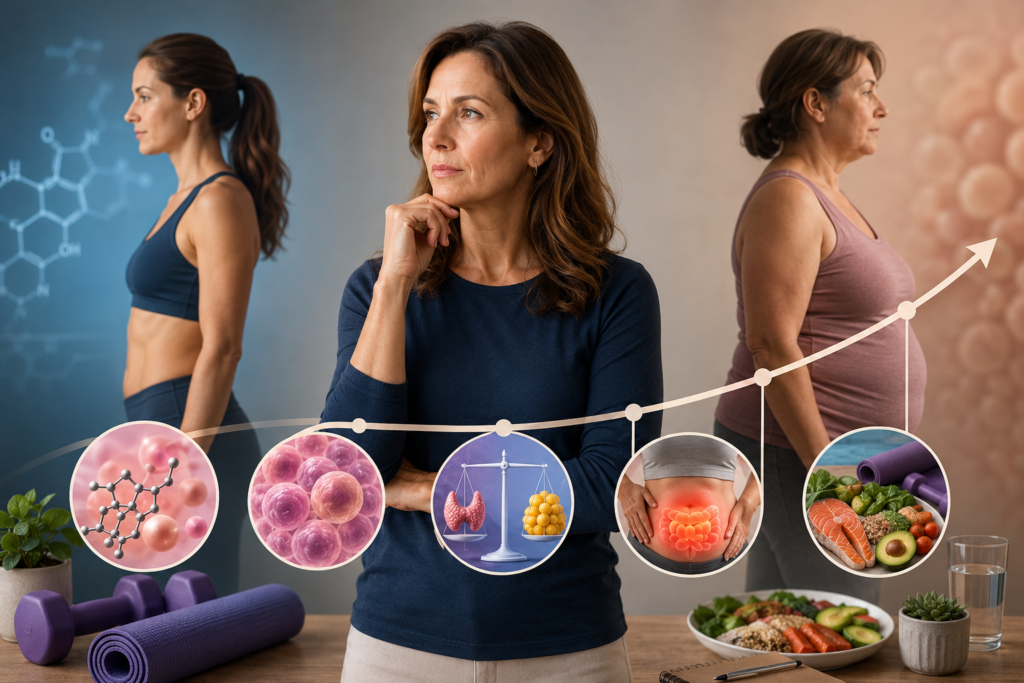
For many of us, weight gain during menopause can feel like it happened suddenly, it can be totally confusing, and deeply personal.
One day everything is working. Next, your body feels unfamiliar and nothing has changed in your diet or exercise routine. The scale creeps up. Belly fat appears seemingly overnight. Your energy shifts. And despite doubling down on eating “healthy” and exercising, nothing seems to move the needle.
But according to a new study published in the journal Menopause called “Trends in obesity among premenopausal and postmenopausal women in the United States between 1999 and 2018”, this shift may actually begin years before menopause officially starts.
That finding matters because it changes the conversation entirely.
This isn’t simply about “getting older” or losing willpower. It’s about biology, hormones, metabolism, and the critical window before menopause when women may have the greatest opportunity to protect their long-term health and future 80 year-old self.
What’s This About?
This study looked at how body weight changed in women before and after menopause over nearly two decades in the United States.
Researchers analyzed data from the National Health and Nutrition Examination Survey (NHANES), one of the largest and most respected health databases in America. Their goal was to understand whether obesity trends differed between premenopausal and postmenopausal women, and how aging itself affects body mass index (BMI).
The key finding?
Weight gain and obesity are increasing in women overall, but the rise is especially noticeable during the years leading up to menopause.
In other words, menopause may not be the starting point. It may be the tipping point.
For a deeper dive into hormones, metabolism, and why weight loss becomes harder in midlife, listen to this episode on the podcast Hack My Age: Menopause Upgrade, featuring the chief scientific officer of MitoQ, Siobhan Mitchell.
When and Who?
The study included more than 26,000 women over age 20 between 1999 and 2018. Researchers divided participants into two groups:
- Premenopausal women
- Postmenopausal women
They then compared BMI trends over time and across different ages and ethnic groups.
BMI, or body mass index, is a screening tool that estimates body fat based on height and weight. While it does not tell the full story of health or body composition, it’s commonly used in population studies to track obesity trends.
What Did They Find?
The researchers found that BMI steadily increased over the 20-year period in both groups of women.
But the most dramatic rise happened in premenopausal women. What? Premenopause?
Average BMI in premenopausal women increased from 27.7 in 1999 to 30.2 in 2018, crossing into the obesity range.
That means many women are entering menopause already metabolically vulnerable.
Researchers also discovered that BMI naturally climbed with age before menopause, peaking around the menopausal transition years.
This helps explain why so many women feel blindsided in their 40s.
It’s not necessarily that they suddenly “let themselves go.” Their hormones, body composition, insulin sensitivity, sleep, stress response, and fat distribution are all changing at once.
And declining estrogen appears to play a major role.
Emerging research shows estrogen helps regulate:
- fat storage
- inflammation
- blood sugar
- appetite signaling
- muscle mass
- energy balance
As estrogen declines, women are more likely to accumulate visceral fat, the deeper abdominal fat linked to heart disease, insulin resistance, and metabolic syndrome.
Why Does This Matter?
This study matters because obesity is not just about appearance.
Excess body fat, especially around the abdomen, is associated with:
- cardiovascular disease
- type 2 diabetes
- fatty liver disease
- inflammation
- cognitive decline
- breast cancer risk after menopause
And importantly, the study suggests intervention should happen earlier.
Instead of waiting until women are fully menopausal and struggling with stubborn weight gain, the premenopausal years may be the most important time to identify metabolic changes and support women proactively.
That shift in perspective is huge.
Because women are often dismissed during this stage.
They’re told:
- “Eat less.”
- “Exercise more.”
- “It’s just aging.”
Meanwhile, many are doing everything “right” and still watching their bodies change.
If you’ve felt that frustration, you are far from alone.
Across online menopause communities, women consistently describe rapid weight gain despite intense exercise, calorie tracking, healthy diets, and active lifestyles.
The science is finally catching up to what women have been saying for years.
What Am I Doing About It?
I believe women deserve better answers than “this is normal.”
Midlife weight gain, let’s be real, this is “extra fat gain”, is complex. Hormones matter. Muscle matters. Sleep matters. Stress matters. Metabolic health matters.
That’s why I focus on helping women understand:
- how estrogen affects metabolism
- why blood sugar becomes more unstable in midlife
- how muscle loss accelerates after 40
- why protein and strength training become non-negotiable
- how poor sleep and chronic stress impact belly fat
- when hormone therapy may support quality of life and metabolic health
Most importantly, I want women to stop blaming themselves.
Your body is not broken.
But it may need a different strategy than the one that worked in your 20s or 30s.
Practical Tips
The goal is not perfection.
The goal is protecting metabolic health before small changes become bigger health problems later.
Here are the strategies with the strongest evidence behind them:
1. Prioritize Strength Training. Muscle is one of the most important predictors of healthy aging.
After menopause, women lose muscle more rapidly, which lowers metabolic rate and makes weight management harder.
Strength training helps preserve:
- muscle mass
- insulin sensitivity
- bone density
- metabolic flexibility
Even two to three sessions per week can make a difference.
2. Eat Adequate Protein. Many, but not all, midlife women are under-eating protein.
Protein supports:
- muscle maintenance
- blood sugar stability
- satiety
- recovery
Aim to include protein at every meal instead of relying heavily on carbs alone. Calculate your personal protein needs based on your activity level and goals.
3. Support Sleep Like Your Life Depends On It (Because it does). Poor sleep increases cravings, insulin resistance, cortisol, and abdominal fat storage. And unfortunately, sleep disruption becomes extremely common during perimenopause and menopause.
Focus on:
- morning sunlight
- consistent sleep schedules
- reducing alcohol
- managing nighttime stress
- optimizing hormones when appropriate
4. Don’t Ignore Stress. Chronic stress changes eating behavior, blood sugar regulation, and fat storage.
Women in midlife are often juggling careers, aging parents, teenagers, relationships, and burnout all at once.
Nervous system regulation matters more than most people realize. This is not a luxury. This is not optional, it’s a dire necessity.
5. Get Your Hormones and Metabolic Health Checked
If your body suddenly feels different, it’s worth investigating.
Consider discussing the following with a qualified healthcare professional:
- fasting insulin
- A1C
- thyroid health
- lipid markers
- inflammatory markers
- perimenopause symptoms
- hormone therapy options
5. GLP-1s. I don’t take weight loss peptides myself, but I have seen (when used properly), it can be a game change for many women in our community. Please do not attempt to use these on your own without the guidance of a professional.
6. Supplements. Supplements are not as powerful as weight loss drugs and certainly not as beneficial as getting the foundation in. But they can be a helpful tool or crutch while you are getting the foundation in place. The two products I have the most information on are Calocurb and Hormonal Metabolic Control. They are backed by solid science and so far I am receiving positive feedback on their efficacy.
This study sends a powerful message: Midlife weight gain does not suddenly appear after menopause.
The process often begins years earlier.
That means women have an opportunity, not to chase unrealistic beauty standards, but to protect their energy, strength, metabolism, and long-term health before symptoms spiral.
And perhaps most importantly, women deserve to understand what’s happening inside their bodies instead of being blamed for it.
Because knowledge is power.
And midlife is not the beginning of decline. It can be the beginning of a smarter, stronger chapter.
FAQ: Midlife Weight Gain & Menopause
Is weight gain inevitable during menopause?
No. While hormonal changes and genetics can make weight management more difficult, lifestyle factors like strength training, sleep, protein intake, stress management, and metabolic health play a major role.
Why does belly fat increase during menopause?
Declining estrogen changes how the body stores fat, often shifting fat storage toward the abdomen and visceral area.
Does menopause slow metabolism?
No, but it feels like it. Researcher Dr. William Li explained in this episode how metabolism doesn’t change due to age or menopause. It changes, because we are gaining fat. Metabolism can slow due to increased fat storage, muscle loss, sleep disruption, and reduced insulin sensitivity.
Can hormone therapy help with menopause weight gain?
Hormone therapy is not a weight-loss treatment, but some research suggests it may help improve body composition, sleep, insulin sensitivity, and overall metabolic health in some women.
What’s the best exercise for women in midlife?
Strength training is one of the most effective forms of exercise for preserving muscle, supporting metabolism, improving bone density, and reducing metabolic risk at any age.
Is BMI the best way to measure health in menopause?
Not necessarily. BMI does not distinguish between fat and muscle. Waist circumference, muscle mass, blood sugar markers, and overall metabolic health may provide a more complete picture.
Zora Benhamou is a gerontologist who studies aging and is dedicated to challenging menopause stigma and ageist stereotypes. As the host of the Hack My Age podcast, she focuses on empowering women navigating the menopausal transition through evidence-based techniques that support your 80 year old self.
Reference: Cook, C. E., Kim, C., Abid, M., Wasser, A., & Banack, H. R. (2025). Trends in obesity among premenopausal and postmenopausal women in the United States between 1999 and 2018: results from the National Health and Nutrition Examination Survey. Menopause.